To write a family history book, decide whose story it tells and how far back it goes, gather the papers and interviews, and check each fact against a record. Then choose an order for the chapters, write each one as a story built on its records, cite every source, add captioned photographs, trees and maps, edit, and print.
Most family history books are written by one person in the family over a year or more of evenings. The work goes well when it is done in order, and badly when the writing starts before the research is checked. This guide sets out the order and gives a chapter outline to copy. What a family history book is explains the kinds of book, and family history book examples shows finished pages.
Key points
- Decide the scope first, whose family and how many generations, since every later choice follows from it.
- Research comes before writing, and every fact goes into the book with the record it came from.
- A book of several generations can be ordered by generation, by branch, or by place and period; the free outline below fits any of them.
- Each chapter reads as a story set in its town and its times, with family memory kept apart from what the records show.
- Every source is cited, every photograph is captioned with who, where and when, and an index lists every name in every spelling.
The steps, in order
- Decide what the book covers: whose descendants or ancestors, how many generations, and which branches.
- Gather the papers and photographs at home, and interview the oldest relatives.
- Find the records behind each person, and keep a log of every source searched.
- Choose the order of the book: by generation, by branch, or by place and period.
- Fill in the chapter outline with the records and stories that belong in each chapter.
- Write the chapters one family at a time, with a note to the source of each fact.
- Add the photographs and documents with captions, and the family trees, timeline and maps.
- Write the front and back matter, from the title page to an index of names.
- Edit, check every name and date against its source, and have relatives read the draft.
- Lay out the pages, print one proof copy, correct it, and print the copies.
Decide what the book covers
A family history can follow one surname back as far as the records go, all the descendants of one couple, or both sides of one person's family. A book of descendants grows wide, with many cousins in each generation. A book of ancestors doubles with every generation: a grandchild has thirty-two ancestors in the fifth generation back.
Write the scope down in a sentence or two before anything else, for example: "The descendants of Hersh and Malka Lieberman of Kalisz, from their marriage in 1878 to the present." Living memory usually reaches the grandparents and sometimes their parents, and anything earlier has to come from records. Many writers finish one side of the family and give the other a second volume.
Smaller family history projects
A booklet on one couple and their children, the life of one grandparent for a milestone birthday, or a book of the family's recipes are all family history projects. Each can later become a chapter of a larger book. How to make a family cookbook covers one of them.
Gather and research before you write
Start with the papers and photographs at home, then the oldest relatives, then the records. What to do with old photos and family papers covers the papers, and questions to ask your grandparents gives the interview. How to trace your ancestry takes the records in order.
From the first day, keep a research log: for every search, the date, the collection, the spellings tried, and what was found or not found. The log becomes the source notes of the book. Give each record you copy a number, and write that number beside every fact you take from it.
Check every index entry against the original record. In the example on this site an index read Nuta Marko as Nuta Tarko, and only the original register settled it. How the example was researched follows the whole process for one family.
How to organize a family history book
The order is the question writers find hardest. A family of several generations can be told in four ways:
| Order | How the book runs | Suits |
|---|---|---|
| By generation, oldest first | From the earliest ancestor down, one generation to each part | A book of one couple's descendants |
| By generation, newest first | From a grandparent back, one generation to each chapter | A book of one person's ancestors |
| By branch | One part for each child of the founding couple, or for each side | Large families, where each branch reads its own part first |
| By place and period | One part for each country or town, in the order of time | Families who moved, and most families of immigrants |
Whatever the order, keep each chapter to one family unit, such as a couple and their children. Begin each part with a short page on who is in it and where it is set, with that branch of the tree, so that a reader who opens the book in the middle knows where they are.
Numbering the people
A long genealogy numbers its people. For ancestors, the usual system is the ahnentafel: the starting person is 1, a person's father is twice that number and the mother twice plus one, so the father is 2, the mother 3, and the father's parents 4 and 5. For descendants, the American standards are the Register and NGSQ systems, described on the examples page.
A free chapter outline for a family history book
This outline is a template for a book organized by place and period, the usual shape for a family that moved from one country to another. For a book by generation or by branch, keep the front and back matter and change the parts in the middle. Copy the table or print this page, and list the records for each chapter as the research comes in.
| Section | What goes in it | What it draws on |
|---|---|---|
| Front matterTitle and copyright pages | The title, a subtitle with the places and years, the author, the year, who holds the rights | The finished book |
| Dedication and contents | A line or two of dedication; every chapter with its page, and a list of maps and trees | The finished layout |
| How this book was made | The sources used, who helped, how names and dates are written | The research log |
| The family at a glance | The family tree, or one for each side, and a short timeline | The person files |
| Part oneThe town and its people | Where the earliest known ancestors lived: its history, community, trades and streets | Town histories, period maps and photographs, the town's memorial book |
| The earliest generations | Who they were, their marriages and children, how they made a living | Registers of births, marriages and deaths; family memory |
| Part twoLeaving | Why they left, the route, the ship, who was left behind | Passenger lists, letters, naturalization papers |
| Part threeThe new country | The first addresses, work, the shul or church, the neighborhood | Census pages, city directories, naturalization files |
| Each household in turn | A chapter for each child's family, or for each decade | Census and vital records, interviews, photographs |
| The years the family remembers | The generation the readers knew, in the words of those who knew them | Recorded interviews, letters, photographs |
| Back matterWhat is still unknown | Each open question, with the records that might answer it | The research log |
| Appendixes | Full transcriptions and translations, longer lists and trees | The records |
| Notes and sources | Where each fact comes from, and every collection searched | Every record cited |
| Glossary and index of names | Words a later reader may not know; every person under every spelling | The final pages |
Generic templates leave out much of what a Jewish family's book needs. The Hebrew names are usually on the gravestone, the ketubah and the family's papers. Keep these for each person, and carry them into the tree and the text:
Checklist
- Every form of the name in the records, with the English, Hebrew and Yiddish names.
- The Hebrew name with the father's name, as on a gravestone or a ketubah.
- Dates of birth, marriage and death, with the Hebrew date beside each death.
- Each town's name in every language it was known by.
- The place of burial: the cemetery, the society or shul plot, the section and row.
- The number of the record behind each fact.
Family history book format and layout
A family history book is read slowly and kept for decades, so its layout should be plain. A book that is mostly text reads well at 6 by 9 inches; one with many photographs, maps and documents needs a larger page, such as 8.5 by 11 inches, so that a record can be read. Use one serif typeface, large enough for the oldest readers, and leave a wider margin at the spine so that nothing is lost in the fold. Put notes at the foot of the page for readers who check sources as they read, or at the back by chapter for a cleaner page.
The parts follow the usual order of a book, as The Chicago Manual of Style sets it out: in front, the title page, copyright page, dedication and contents, then any preface; at the back, the appendixes, notes, glossary, bibliography and index. Put each record on the page where the text discusses it, and keep long transcriptions for an appendix. Inside a book shows these choices in a finished family history.
How to write a family history narrative from the records
Many first drafts list names and dates under each person and stop there. The records hold far more. An American census page of the early twentieth century gives the street, the trade, the year of arrival and the neighbors. A ship's list of the same years gives the town, the relative left behind and the one being joined. Each of these is a sentence in the story.
A recipe for writing each chapter
- Lay out the chapter's records in order of date, with a line on what each says.
- Write down what the family remembers about the same years, and who remembers it.
- Read about the town and the time: its history, its trades, the events around the family.
- Open with one scene a record supports, such as a wedding or an arrival.
- Tell the rest in order, saying which parts come from records and which from memory.
- Close with what is still unknown, and where the next chapter picks up.
Keep the two voices apart. "The family remembers that he left in 1912; the ship's list shows him landing in New York in March 1913" tells the reader what is known and how. When records disagree, set them side by side and say which the book follows and why. In the example, one woman's papers give five different dates of birth, and the book tests each against the births of her sisters before choosing one.
Do not invent what no one recorded. Where the records are silent, a writer can tell what happened to others in the same place, from their own accounts, and say so plainly. Quote the person's own words from letters and recorded interviews wherever they exist.
Living relatives, and a style that lasts
Show living relatives the passages about them, and leave out what they would not want printed. Write in the past tense and in plain words, give dates in one form throughout, such as 12 March 1913, and give the Hebrew date beside it where the record has one.
Citing sources in a family history book
Every fact should lead back to its record. Genealogists work to the Genealogical Proof Standard of the Board for Certification of Genealogists, which asks for reasonably exhaustive research, complete and accurate citations, analysis of the evidence, the resolution of conflicts between sources, and a soundly reasoned conclusion. A family book need not argue every point at that length. It should still cite every source.
A citation says who made the record, what it is, when it was made, and where it is held, down to the volume, page or entry. For a record seen online, add the collection and the date seen. For family memory, cite the person and the date: "Interview with Esther Klein, 4 June 2025; recording held by the author." The standard guide is Elizabeth Shown Mills's Evidence Explained.
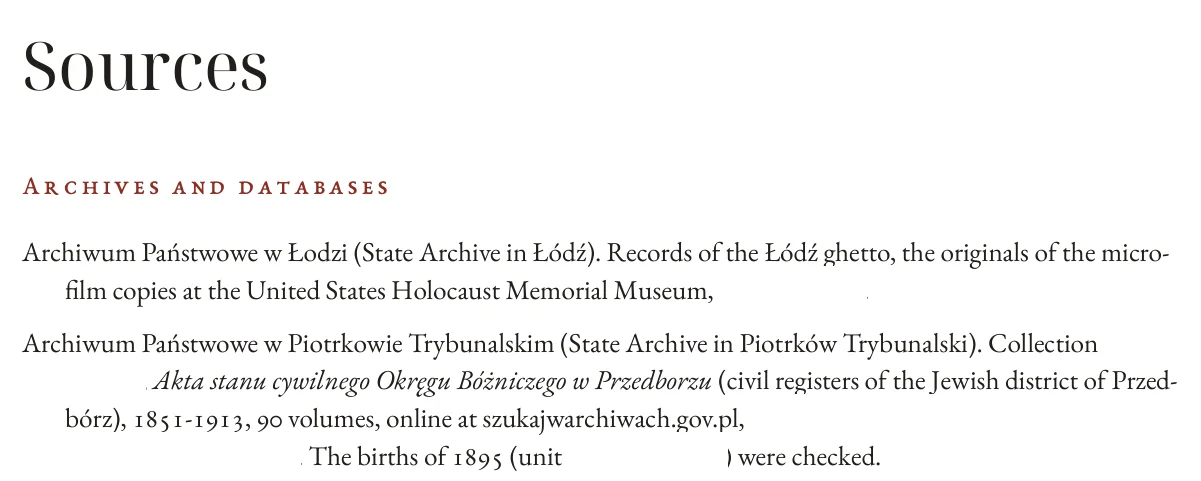
A list of sources at the back, grouped by archive, shows a later researcher what was searched. Family history book examples shows how one book sets its records beside their translations and source notes.
Photographs and documents, with captions
Choose photographs for what they tell. Use a copy made from the original at a resolution that suits the printed size; the Library of Congress suggests 300 dots per inch for ordinary prints and 400 to 600 for one that may be enlarged. What to do with old family photos and papers covers copying and labeling.
A good caption names every person from left to right, with the place and the year, says who identified them, and says where the original is kept: "Malka and Hersh Lieberman with their four children, Kalisz, about 1902. Identified by their granddaughter Esther Klein. Original held by the Klein family." Show documents large enough to read, with a caption that says what each proves and does not prove, and give a transcription and a translation beside it or in an appendix. Old Yiddish and Hebrew letters explains how letters are read.
Family trees, timelines and maps
A tree at the front lets a reader find anyone. A tree of five or six generations rarely fits one page, so divide it, with one chart for each side or each branch, set on facing pages where the branches meet. Give each person every spelling of the name, and the Hebrew name.
A timeline helps most where several people move between countries in the same years: one column for each person and one row for each year, with each move and marriage marked by its date.
Maps let a reader follow the moves. For American towns, the Library of Congress has put online its Sanborn fire insurance maps, made from 1867 into the 1960s, which show street by street the outline of each building with its house number; nearly every sheet in the public domain can be seen free. For towns in Eastern Europe, many yizkor books, the memorial books former residents wrote for their towns, include a plan of the town drawn from memory.
The appendix and glossary of a family history book
An appendix holds material too long for the chapters, such as full transcriptions and translations of documents, or a list of everyone buried in a family plot. In the example, every document pictured is translated in full at the back, in a section called "The documents in English".
A glossary explains the words a reader in fifty years may not know: in a Jewish family's book, words such as landsmanshaft, a society of people from the same town, or chevra kadisha, the burial society, and the terms of the records, such as a declaration of intention, the first step toward American citizenship. List the words alphabetically, each with a one-sentence definition, after the notes and before the index. Explain each word in the text at first mention too.
The index of names is how relatives find their own people. List every person under every spelling, with cross-references, and married women under the name they were born with. Make it last, once the page numbers are final.
Family history book titles and covers
The plainest titles last best: the family name, with a subtitle that gives the places and the years. The example on this site is called The Tarko Family, and its first volume is subtitled Book One of Two: Poland, 1895 to 1945. Other patterns that work:
- The name with places and years: The Liebermans of Kalisz and Cleveland, 1850 to 2025.
- The founding couple: The Descendants of Hersh and Malka Lieberman.
- A phrase from the family: A House on Orchard Street: The Lieberman Family in New York.
- Both sides: The Lieberman and Feldman Families, each side a part of the book.
For the cover, one strong image does more than a collage, such as the earliest photograph of the founding couple. Put the title and family name on the spine, where they are read on a shelf. Printing a family history book compares covers and bindings.
Editing and checking the draft
Put the draft away for a few weeks, then read it aloud. Check every name, date and place against the person files, and every caption against its photograph. Then send it to readers in this order: the oldest relatives, who can correct names and add memories; one cousin from each branch; anyone living who is written about; and last a proofreader. Allow a month for replies, and expect new photographs to arrive with them.
Printing and sharing the book
Order one printed proof and correct it before ordering a copy for each household, and give a copy to a library. Printing a family history book covers formats, binding, the number of copies and what they cost.
What no template can do
An outline gives the book its shape. It cannot write to an archive in Poland or Lithuania, or read a register kept in Russian, and it cannot tell whether an index entry belongs to your family. For many families those are the chapters before the immigrant generation, and they take the longest. Doing it yourself or commissioning it helps decide which parts to do yourselves.
Sources: the Board for Certification of Genealogists on the Genealogical Proof Standard; Elizabeth Shown Mills, Evidence Explained: Citing History Sources from Artifacts to Cyberspace; The Chicago Manual of Style on the order of a book's parts; Penelope L. Stratton and Henry B. Hoff, Guide to Genealogical Writing (New England Historic Genealogical Society), and Patricia Law Hatcher, Producing a Quality Family History; the Library of Congress on its Sanborn fire insurance maps, on the works of 1930 entering the public domain and on donating a family history; FamilySearch on donated books. Checked October 2026.
Questions families ask
Is there a template for a family history book?
Yes. The chapter outline on this page is a free template: front matter, parts by place and period, and back matter with appendixes, notes, a glossary and an index of names. Copy it or print the page. For a Jewish family, add room for each person's Hebrew name with the father's name, the Hebrew date of death and the place of burial.
How should I lay out a family history book?
Keep it plain: one serif typeface, a wider margin at the spine, captions under every photograph, and notes at the foot of the page or at the back. A book that is mostly text suits a 6 by 9 inch page, and a book of photographs and documents a larger one. Put each record beside the text that discusses it.
How do I organize a family history across several generations?
Choose one of four orders: by generation from the earliest ancestor down, by generation from the present back, by branch, or by place and period for a family that moved. Keep each chapter to one family unit, start each part with its piece of the tree, and in a long book number the people.
How do I start writing my family history?
Write the scope in a sentence or two, gather what the family holds, and interview the oldest relatives, keeping a log of every source from the first day. Then begin with a chapter you know well, such as the grandparents' generation, instead of the earliest one, and let it set the style for the rest.
How do I turn names and dates into a family history narrative?
Read each record for everything it holds, such as a street, a trade or a relative left behind, and read about the town and the times. Open each chapter with one scene a record supports, then tell the rest in order, saying which parts come from records and which from memory.
Can I write about living relatives in a family history book?
Yes, with their agreement. Show each living person the passages about them, and leave out what they would not want printed. If the book will go to a library or be sold, leave out the birth dates and addresses of living people; FamilySearch, for one, accepts donated books only when they leave out such details.
A researched book for your family
Zichronos researches a family in the archives that hold its records, then publishes its history as a finished hardcover book. We do the work this page describes as one commission: we start from the family's papers and its oldest relatives, write to the archives in the countries the family came from, translate what comes back, and write and design the book with the source of every fact in its notes. A standard commission includes five hardcover copies and a PDF, and most take three to four months. Family history book examples shows such a book's pages, what a family history book costs compares every kind of service, and How we work sets out the steps.
More in family history books